 This was a fairly lazy morning and most of us slept late. Then, David, Kaylynn, Alyssa, Pamela, and Jimi took a dinghy over to a snorkeling spot near the anchorage. It was a good spot with lots of fish and some caves. A huge school of small fish swam under Jimi and Kaylynn which was amazing to watch.
After breakfast and snorkeling we loaded up and went south to the town of Basse Tere to look for fresh water for showers and cooking. It was a very scenic sail and we got great pictures of the rain clouds coming through the mountains. Overall Guadeloupe was probably the most picturesque island we visited. However, the marina at Basse Tere was a ghost town on Sunday afternoon. We found someone who told us where to get water ('borrow' it actually since there was no one there to pay) but we couldn't do it because we didn't have a hose on board.
 Having failed to find water at Basse Tere we sailed further south to the Saints. The Saints are a pretty little group of islands just off the southern coast of Guadeloupe which are quite popular with sailors. It was a fairly bouncy sail but it was a short passage (only about an hour) and we ended up at a very pretty harbor. In the harbor at the Saints we found a “water buoy” run by an enterprising guy named Jerome. It was a buoy with a hose attached that ran all the way to the shore. We payed 40 Euros for as much water as we wanted. The girls all showered while we filled up. It was expensive but solved our water problems. (We then had the problem of finding 40 Euros since Jerome didn't take dollars or credit cards but that's part of tomorrow's story.)
The anchorage was fairly large but only some parts of it were protected enough for quiet night's sleep. We finally anchored over near the main part of town. It was tricky to find a good spot and we ended up fairly close to shore. We dived on the anchor and it seemed to be well placed in sand (though there were rocks nearby).
Patti made steaks (and some chicken and rice for Jimi). We thought about going into town for drinks but decided we were all too tired. We did get some great pictures of the sunset. It was impressive enough that Jimi and Dave got into the dingy to get pictures of our boat with the sunset as background.



 Most shops were closed because of a local holiday and because it was the low season. It was nice to have the place to ourselves but it was tricky to find an open place for dinner. We talked to various people and found that the best place still open was a restaurant called Trappas on the road into town. Following their directions Paula drove the dinghy way down the harbor to an older dinghy dock. Then we climbed through a hole in the fence and crossed the road to get to Trappas. Then we had to undo it all to get back to our boat before dark.


 After anchoring, David, Pamela, and Jimi took the dingy over to the wreck and tied off to the top of the smoke stack. It was a very cool place to snorkel but would have been better if there was more sun – they finished the dive right at sunset. There were lots of jelly fish to dodge (no one got stung) and Jimi saw a big barracuda. The rest of the crew climbed the hill to the ruins of Fort Barrington on the ridge top. Kaylynn took Jimi up quickly after the dive. The ruins were amazing, and it was easy to imagine why the fort was built there to protect the entrance to Deep Bay and St. John's (an important town in the next bay over). There were great views into Deep Bay and over to St. Johns.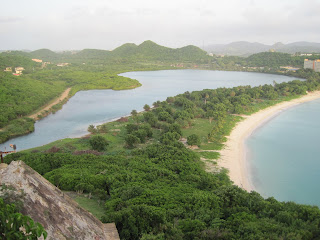


 The anchorage was fairly crowded by sunset with mostly French boats. After dinner David played guitar and we all sang – no doubt amusing the French.

 We then motored around St. Martin and dropped anchor at Orient Beach behind Green Cay. It was very shallow – the depth gauge showed less than a foot of water below the keel (we checked by snorkel and verified that we had about 2 feet). There was a lot of current so it was not a great place for swimming.
 This was our last morning on the boat. Kaylynn and Jimi woke up early and went to explore Isle Pinel. They tried to row in to avoid waking everyone with the sound of the dingy engine. They discovered that it is very hard to row an 8 person dingy against the wind. On shore they found a kind of hermit crab that lived on land, and great views of the boat and Orient Beach from the top of the hills.
